🔍 Suspicious message?
Analyze senders, links or files in real time with our scanner.
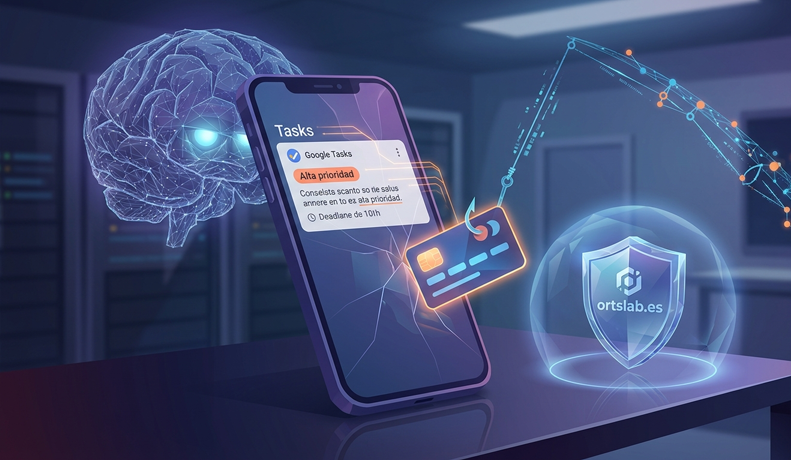
What makes this attack especially dangerous is not its technical complexity, but its origin. The victim receives an authentic notification from @google.com. By using Google's own infrastructure to deliver the bait, attackers manage to bypass traditional spam filters and, even worse, deactivate the user's psychological alarms.
Artificial Intelligence: A New Engine for Fraud
This scenario becomes even more complex with the rise of Artificial Intelligence (AI). Unfortunately, the development of these technologies is also being exploited with malicious intent by cybercriminals. AI now allows for the generation of "tailor-made" deceptions that force our defenses to focus not just on detecting known viruses, but on understanding malicious intent.
We believe that AI will generate sophisticated variants of attacks such as:
- Hyper-personalized Phishing: Messages that perfectly mimic the writing style of colleagues or executives.
- Advanced Snooping: Digital observation techniques to launch attacks at the exact moment a user expects a notification.
- Dynamic Variations: Message hooks will constantly change to avoid detection by static filters.
Anatomy of a Task-Based Attack
The process is surgical and relies on psychological triggers designed to make the employee act on impulse. Common elements usually include:
- Authority: Using an official platform like Google creates a false sense of security.
- Urgency: Titles such as "Immediate contract review" or "Action required."
- Time Scarcity: Extremely tight deadlines or "High Priority" labels are assigned.
How Context Detection Protects ortslab.es
At ortslab.es, we have implemented a social engineering context detection system that analyzes suspicious behavior patterns in real-time through three critical layers:
1. The Urgency and Pressure Traffic Light
Our system scans the message body for pressure words like "pending task" or "deadline expiration." If language designed to generate stress is detected, the security level is elevated.
2. Trust Chain Inconsistency
We identify the contradiction of receiving a notification from a legitimate sender (Google) that redirects to an external domain unrelated to the company. We cut off access before the user even clicks.
3. Shielding Against Credential Theft
We monitor login forms. If an unauthorized website requests corporate credentials, the system intervenes by blocking the outbound flow of sensitive data to protect the user's identity.
Prevention Strategies for Organizations
Although technology provides a robust safety net, prevention depends on a comprehensive strategy:
- Awareness: Inform employees about these schemes and teach them to identify red flags.
- Process Definition: Maintain a corporate document listing the tools and services authorized by the company.
- Automated Training: Use attack simulation platforms to train staff response.
- Workstation Security: Ensure all devices have protection software capable of blocking malicious sites in real-time.
Checklist: How to tell if a task is a phishing attempt?
Before clicking on any notification from Google Tasks or similar services, verify these points:
- Do I know the person assigning the task? If it is an unknown or external name, exercise extreme caution.
- Does the link lead to an official domain? Hover your mouse over the link to see the actual address before clicking.
- Is it asking for my password? No legitimate task service should ask for your corporate credentials on an external website.
- Is there excessive urgency? If the tone is threatening or overly rushed, it is usually a trap.
In summary, when faced with phishing that utilizes legitimate tools and relies on AI, the response must be a combination of intelligent technology and trained personnel. Total security does not exist, but early context detection at ortslab.es brings us much closer to it.
Correo falso de Amazon: cómo detectar el phishing de suplantaciónForensic Analysis of a Fraudulent Email: Amazon Impersonation