🔍 Suspicious message?
Analyze senders, links or files in real time with our scanner.
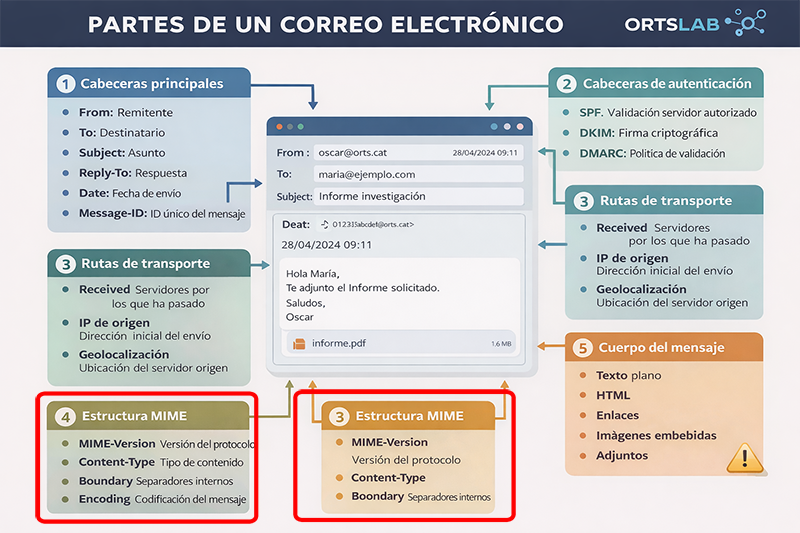
MIME-Version
The MIME-Version field indicates the version of the standard used to structure the message. Although it is usually stable, its absence or unusual values can be signs of illegitimate sending tools.- The most common version is 1.0.
- Its absence may indicate a non-standard transmission.
- Strange values can reveal malicious or automated software.
Content-Type
The Content-Type field defines the type of content in the message and how it should be interpreted. It is one of the most important elements for understanding the internal structure.- It can be plain text, HTML, or multipart.
- In multipart messages, each part contains a different type of content.
- Attackers often hide malicious content in secondary parts.
Boundary
The boundary is a separator that delimits the different parts of the message when the email is multipart. It allows the message to contain several independent sections.- It identifies where each part of the message begins and ends.
- It can reveal if the message has been manipulated.
- Inconsistent boundaries can indicate fraudulent sending tools.
Encoding
The Encoding field defines how the content is encoded for transport. It is especially relevant for attachments and non-textual content.- The most common methods are base64 and quoted-printable.
- Malicious attachments are often encoded in base64.
- Unusual encodings can be an indicator of manipulation.