Online Fraud in the BTS ARIRANG Tour: Fake Tickets and Cloned Websites
The announcement of the BTS ARIRANG world tour—the South Korean group's first major tour after a four-year absence due to mandatory military service—has unleashed a wave of excitement… and an international campaign of online ticket fraud. Millions of fans rushed to buy as soon as the news broke, and that urgency has become the scammers' best ally.
🔍 Suspicious message?
Analyze senders, links or files in real time with our scanner.
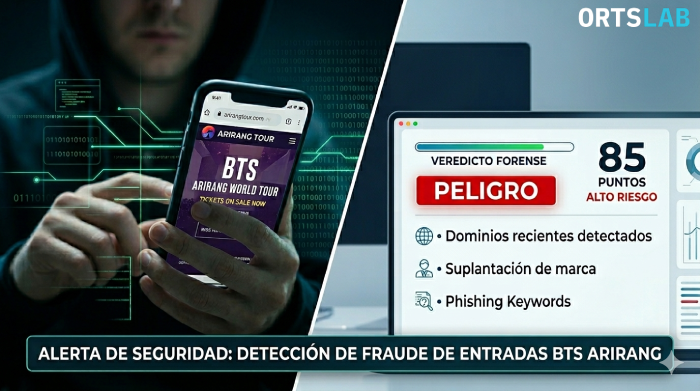
Researchers from Kaspersky have identified at least ten fraudulent domains active since early April 2026, designed to impersonate official ticket pre-sale pages for dates in Argentina, Brazil, Chile, Colombia, France, Mexico, Peru, Portugal, and Spain. These are not crude imitations: the websites clone the design, structure, logos, and checkout flow of legitimate portals, making it practically impossible to detect the deception at a glance.
The Most Sophisticated Deception: The Case of Brazil
The most elaborate attack vector of this campaign has been documented in Brazil, where the concert organizers had implemented a face-to-face "pre-reservation" system to combat automated scalpers: the user reserves the ticket online and pays physically at the box office.
This anti-fraud measure generated so much confusion that it became fertile ground for scammers. Fraudulent pages exploited the uncertainty with a very well-crafted script:
- First, they presented the card payment option, giving an appearance of normality.
- Next, they generated error messages or "high demand" notices.
- Finally, they pushed the user toward payment via PIX, the Central Bank of Brazil's instant transfer system.
Once the PIX transfer was made, the money passed through money mule accounts, making recovery virtually impossible for both the victim and the authorities. The mechanism is not new, but it is especially cruel: it exploits the legitimate bewilderment of a buyer who has read that the official system is unusual and finds no solid reason to doubt when the fraudulent website reproduces exactly that rarity.
Ten Domains, One Infrastructure, Thousands of Potential Victims
What distinguishes this campaign from an isolated opportunistic fraud is its industrial nature. Ten coordinated domains, registered in a matter of days, with cloned designs and functional purchase flows are not improvised: they require resources, experience, and, above all, preparation time prior to the official tour announcement.
In digital fraud forensics, this is a known pattern: attackers monitor public rumors—leaks, artist statements, social media speculation—and register domains before the news is official. When the announcement arrives and demand explodes, the fraudulent infrastructure is already operational and ready to capture victims.
What ORTSLAB Would Have Detected in the BTS ARIRANG Campaign
The ORTSLAB.ES communications forensic analysis engine is designed specifically to identify this type of fraudulent infrastructure before the user clicks. In a campaign like BTS ARIRANG, the analysis would have triggered several simultaneous key signals to detect ticket phishing:
1. Domain Age (RDAP Signal)
The fraudulent domains were registered in early April, days before the mass tour announcement. The engine penalizes:
- +20 points for domains less than 30 days old.
- +35 points for domains less than 7 days old.
In this campaign, both conditions would be met for most of the identified domains, immediately raising the risk level.
2. Homographs and Spelling Variations
Fraudulent domains mimic official ones through:
- Additional hyphens or subtle changes in structure.
- Substitution of letters with numbers (e.g., "0" instead of "o").
- Alternative TLDs (such as .net, .shop, .info) to appear legitimate during a quick read.
The engine detects these substitutions in both the sender's domain and the URLs included in the messages.
3. Phishing Keywords on the Destination Page
The cloned pages contain terms like payment, verify, tickets, or confirm in strategic positions. The ORTSLAB content analyzer identifies them as red flags during the link validation phase.
4. Brand Impersonation (B4 Signal, +35 points)
When the visible name of the sender or the website matches recognized brands—HYBE, Weverse, Ticketmaster—but the domain is not on the verified whitelist, the engine registers it as high-confidence identity theft and adds 35 additional points.
The combination of these four signals in a single message or link would place the result in the DANGER range of the forensic verdict, with a cumulative score well exceeding the 60-point threshold.
Why This Fraud Works So Well
The effectiveness of these campaigns is not so much due to exceptional technology as to a precise understanding of target psychology. A fan who has been waiting months for their group's return, who enters the site just as sales open, who sees how tickets sell out in minutes on all official channels, and who finds a page offering a last chance, is not in a position to calmly analyze the domain in the address bar.
Scammers do not trick careless people: they trick people at the moment when urgency overrides skepticism. It is the same mechanic that operates in:
- SEPA fraud and urgent transfers.
- Pending package scams and fake courier companies.
- Job offers that are too good to be true.
The variable is not the victim, but the emotional context in which the attack occurs.
How to Protect Yourself from Fake BTS ARIRANG Tickets
The recommendations to avoid falling for this type of cyber-scam are easy to state but difficult to follow in the heat of the moment, precisely because attackers design their campaigns so that urgency makes them seem reasonable.
- Access only official pages: Enter the ARIRANG tour pre-sale only from the verified BTS website or the Weverse platform. Check the domain in the address bar before entering any data: additional hyphens, unusual TLDs, or character substitutions are unmistakable warning signs.
- Attention to the Brazil Case: During the pre-reservation phase, any request for online payment should be interpreted as a sign of fraud. The legitimate system does not request any payment prior to the box office visit.
- Analyze Suspicious Links: If you receive a link via email, SMS, or social media related to ticket purchases, analyze it at ortslab.es before clicking. The engine takes less than ten seconds to detect if the domain is recent, if the page contains phishing signals, or if the sender is impersonating a known brand.
- Distrust Bargains and "Exclusive" Access: Any offer of discounted tickets or free access to exclusive pre-sales outside of official channels should be considered high risk. If the price is too good or access is too easy when all other channels are sold out, the probability of fraud is very high.
Technological Risk and Digital Security Observatory
This article is part of the ORTSLAB.ES Technological Risk and Digital Security Observatory, where active fraud campaigns are documented and analyzed with the aim of informing the public and contributing to cyber-scam prevention.
In a context of global tours, massive fandoms, and impulsive purchases made in seconds, having automated forensic analysis tools and a basic cybersecurity culture is the difference between experiencing the concert of a lifetime or discovering too late that your ticket never existed.
Email falso de Hacienda: cómo detectar el phishing fiscal en la campaña de la renta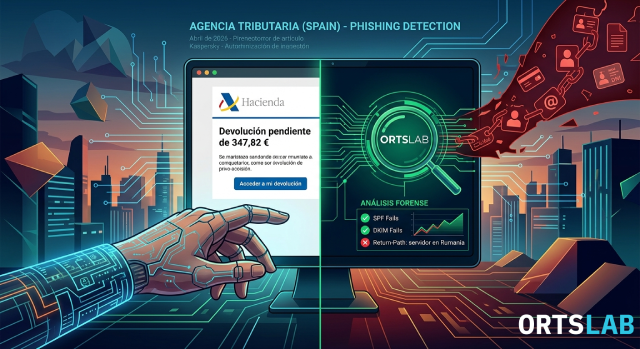
Por qué proliferan los correos falsos de Hacienda en primavera