🔍 Suspicious message?
Analyze senders, links or files in real time with our scanner.
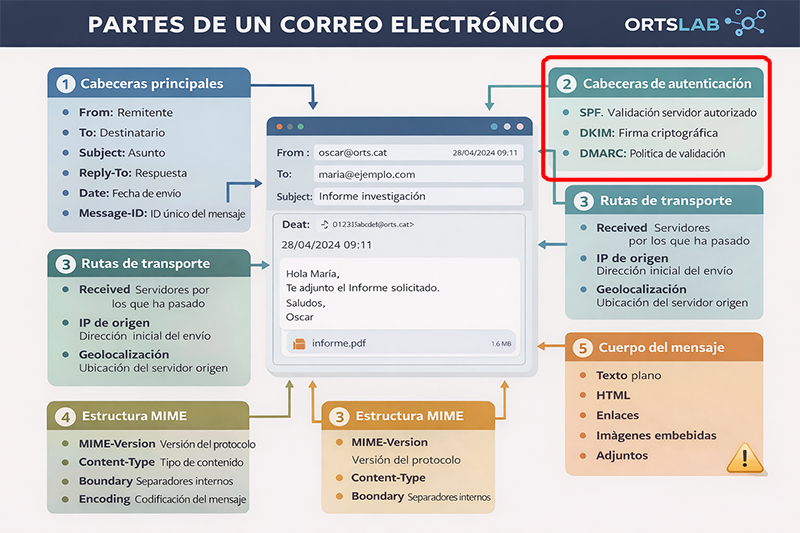
SPF (Sender Policy Framework)
The SPF record defines which servers are authorized to send email on behalf of a domain. When a message arrives at the destination server, it checks if the sending IP is included in the domain's SPF policy.- Allows validating if the sending server is authorized.
- Does not protect the message content, only the legitimacy of the server.
- An SPF failure does not necessarily imply fraud, but it does require review.
DKIM (DomainKeys Identified Mail)
The DKIM system adds a cryptographic signature to the message. This signature is generated at the sending server and validated at the receiving server using a public key published in the domain's DNS.- Guarantees that the content has not been modified during transit.
- The signature must match the sender's domain.
- It is one of the most reliable signals of message integrity.
DMARC (Domain-based Message Authentication, Reporting and Conformance)
The DMARC policy combines SPF and DKIM to establish validation and alignment rules. It allows the domain to indicate what should be done if a message fails the checks.- Defines policies: none, quarantine, or reject.
- Requires alignment between the visible domain and the domains used in SPF and DKIM.
- Allows receiving reports on spoofing attempts.