"Please note that we have changed banks. From now on, kindly make all payments to the new account shown on the attached invoice." The e-mail looks like it comes from your usual supplier, the invoice is identical to last month's and the amount is right. The only thing that has changed is the account number. And that account does not belong to the supplier.
On 6 November, Spanish media reported that a company in Brenes (Seville) had paid 20,000 euros this way. When it called its bank to check the payment, the account turned out not to be the supplier's and the transfer could no longer be reversed. At the end of September, Spain's Guardia Civil reported an investigation into 60 people suspected of defrauding olive oil companies in Córdoba and other firms in Seville with the same trick, with around 475,000 euros frozen. And it is not just a Spanish problem: the FBI estimates that this kind of business e-mail fraud cost more than 3 billion dollars in 2025 in the United States alone.
🔍 Suspicious message?
Analyze senders, links or files in real time with our scanner.
How it works
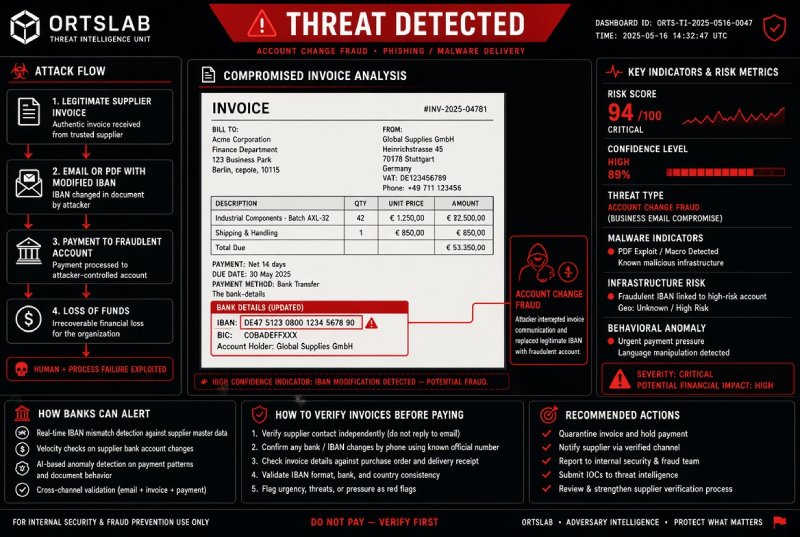
- First, they listen. The fraudsters get into the supplier's mailbox, or yours, usually with a stolen password. From inside they read for weeks: who invoices whom, how much and when.
- Then, they copy. They take a real invoice and change only the IBAN. The logo, invoice number, items and amount are the usual ones.
- And they send it at the right moment. It arrives when payment is due, sometimes as a reply inside a real conversation. If they cannot use the supplier's mailbox, they write from an almost identical domain: one letter changed, an extra hyphen or a different ending.
- With a little pressure. "Please confirm the payment today", "the old account will be closed this week". Just enough to make sure nobody checks anything.
Why it works
Because there is nothing odd to see. No spelling mistakes, no links, no dangerous files. If the e-mail comes from the supplier's real account, the technical checks on the message pass. And whoever pays the invoices does it many times a month: a change of account with a reasonable explanation does not stand out. What gives the fraud away is not how the e-mail looks but the details: an IBAN from another bank or another country, a domain that is not quite the usual one, a domain registered a few days ago, or a PDF edited with a different program from the one the supplier uses.
What your bank already warns you about
Since 9 October 2025, banks in the European Union must check, free of charge and before every euro transfer, whether the payee name you type matches the account holder. The answer can be "match", "close match", "no match" or "could not be verified". In this fraud the account is usually in someone else's name, so the bank will normally warn you that the name does not match.
That warning is your last chance to stop the payment. If you go ahead, the money is sent anyway and, as the Bank of Spain explains, the bank is not liable for sending it to the wrong person. And the real supplier still has not been paid.
Don't do this:
- Don't change a supplier's bank account just because an e-mail asks you to, even if it comes from their usual address.
- Don't call the phone number in that e-mail or on the new invoice: it may be the fraudster's.
- Don't reply to the e-mail to ask whether it is genuine: if the mailbox is in someone else's hands, they will be the ones answering.
- Don't ignore your bank's "no match" or "close match" warning. It is not a glitch.
- Don't let urgency decide: no serious supplier loses a customer because you waited a day to confirm a payment.
Do this:
- Before paying a new account, call the supplier on the number you already had, not the one in the e-mail, and speak to someone you know.
- Compare the IBAN with previous invoices. If it belongs to another bank or another country, be twice as careful.
- Run the e-mail or the invoice PDF through the Crosscheck at ortslab.es (Tools → Crosscheck). It tells you who really sent it, whether the domain is the usual one or a look-alike, how long it has been registered, which bank and country the account belongs to, whether the PDF has been edited and whether the message uses the typical phrases of this fraud. If you enter the supplier's usual e-mail or the account you used to pay, the sheet also tells you whether they match.
- In your business, set one simple rule: no change of bank details is applied without a confirmation call, and large payments are reviewed by a second person.
- Protect your e-mail with a unique password and two-step verification. Many of these frauds start with a mailbox that has been broken into.
- If you have already paid, call your bank straight away to try to stop the transfer: the sooner, the better the chances. Keep the e-mail, the invoice and the payment receipt, report it to the police and warn the supplier by phone, because their mailbox may still be in someone else's hands. In Spain you can also get advice from INCIBE's free, confidential 017 helpline.
This fraud does not need to fool you with anything strange, only with an invoice that looks like the usual one. So the defence is not to look harder at the e-mail but to have a habit: a new account is not paid until someone has confirmed it by phone.