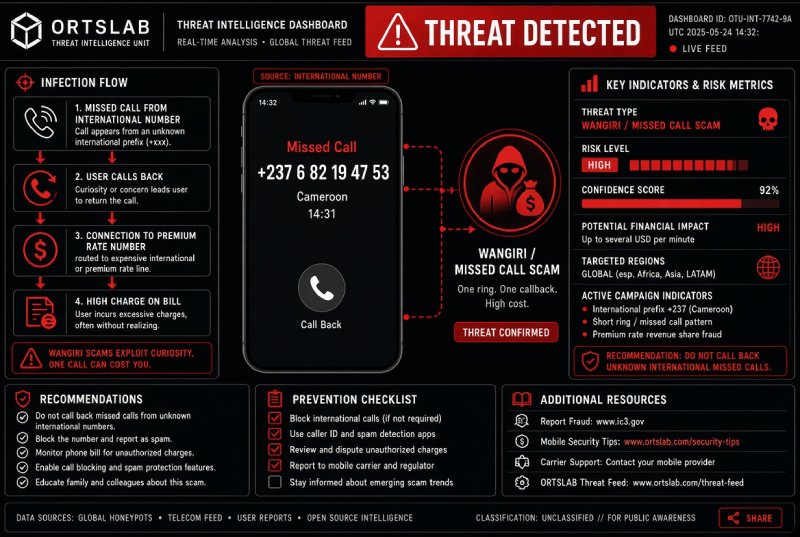
A number you don't know calls you, rings once and hangs up. You are left with a missed call on your screen and a question: who was that? If you call back, the person making money is not someone who dialled a wrong number but someone who has turned your curiosity into a business. This scam is called wangiri, from the Japanese for "one ring and cut".
On 18 November, security firm ESET explained it on its WeLiveSecurity blog: the scam combines automated mass dialling with special-rate numbers that share what they charge with whoever controls them. In Spain, the press has spent months reporting warnings about missed calls from international prefixes.
🔍 Suspicious message?
Analyze senders, links or files in real time with our scanner.
How it works
- First, they call thousands of numbers. A program dials on its own and hangs up after one or two rings. It costs almost nothing, so it is enough for a small share of people to call back. The number usually has a foreign prefix.
- Then, they wait for you to call back. If you do, you are connected to a special-rate number, usually an international one, that starts charging by the minute. Sometimes you hear a recording about a prize or an important delivery, to keep you on the line.
- And they keep a share. Whoever controls that number gets part of the money the calls bring in. You pay for it on your mobile bill.
Why it works
Because the call asks you for nothing. There is no link and no data to hand over: just a missed call and your curiosity. Everyone has seen an unknown number and wondered if it was the school, a delivery, the doctor or a relative on a different phone. Calling back feels polite, and it is exactly what they are counting on. According to the GLF Fraud Report 2025, quoted by ESET, 45% of the telecom carriers surveyed worldwide had experienced a high volume of this kind of scam, up from 38% in 2021.
Which numbers cost more in Spain
Not every number costs the same. In Spain, numbers starting with 803 (adult services), 806 (leisure and entertainment), 807 (professional and information services) and 905 (mass-call services, such as TV voting) are premium-rate: the price per minute is far higher than a normal call. In other cases the number you call back belongs to another country, and what you pay depends on your plan and your operator. If you want to avoid calling these numbers by mistake, you can ask your operator to disconnect them.
Don't do this:
- Don't call back an unknown number that hangs up after a few rings.
- Don't call if you then get a text offering a time-limited prize or threatening you with a fine.
- Don't be swayed by a recording that promises a prize, a parcel or an inheritance.
- Don't give personal or banking details if, when you call back, someone asks for them.
Do this:
- Before calling back a missed call, search for the number online. Bear in mind these numbers change often, so not finding it does not mean it can be trusted.
- Paste the number into Tools at ortslab.com. It tells you which country the prefix belongs to, whether the format is valid, whether it is a Spanish premium-rate number (803, 806, 807 or 905) and whether it has already appeared in scam messages ORTSLAB has detected. Not appearing does not mean it can be trusted, only that we have not seen it yet.
- Block the number. Some phones flag spam calls on their own.
- Check your mobile bill for international or special-rate charges.
- If you have already called back: hang up, dispute the charges with your operator as fraud and, if you gave any banking details, tell your bank. If you gave away a password, change it.
This scam doesn't need to trick you with anything strange, only to count on you being polite and curious. So the defence is not a technical trick but a simple rule: you don't call back a missed call from a stranger. If it was important, they will call again.